Inside FRP Manufacturing: From Material Science to Precision Processes

FRP manufacturing goes beyond shaping materials—it is about engineering performance at a fundamental level. Built on the integration of reinforcing fibers and polymer matrices, FRP delivers a unique combination of strength, flexibility, and longevity. Today, it plays a critical role in industries that demand reliability under real-world conditions, from mobility and construction to specialized applications. What makes FRP truly powerful is not just its composition, but the precision-driven processes that bring it to life.
Fiber Reinforced Plastic (FRP) is a composite material made by combining a polymer matrix with reinforcing fibers such as glass, carbon, or aramid. The result is a material that is lightweight, corrosion-resistant, and structurally strong, making it ideal for applications where durability meets performance.
FRP has steadily replaced traditional materials like metal in many sectors—not because it’s cheaper, but because it’s smarter in performance. It enables complex shapes, reduces weight, and enhances lifecycle efficiency.
But the real strength of FRP doesn’t just lie in the material.
It lies in how it is processed.
The Core Processes That Shape FRP Manufacturing
LRTM (Light Resin Transfer Moulding)
Light Resin Transfer Moulding (LRTM) is a closed-mould process in which resin is injected into a fibre preform within a sealed mould cavity, ensuring controlled and uniform distribution of material. This method significantly improves surface finish while reducing emissions and material wastage, making it both efficient and environmentally responsible. Because the process operates in a controlled environment, it enables high repeatability and dimensional accuracy, which is critical for structural components. LRTM ultimately plays a key role in delivering consistency and precision in FRP manufacturing, especially where performance and finish cannot be compromised.
Lamination
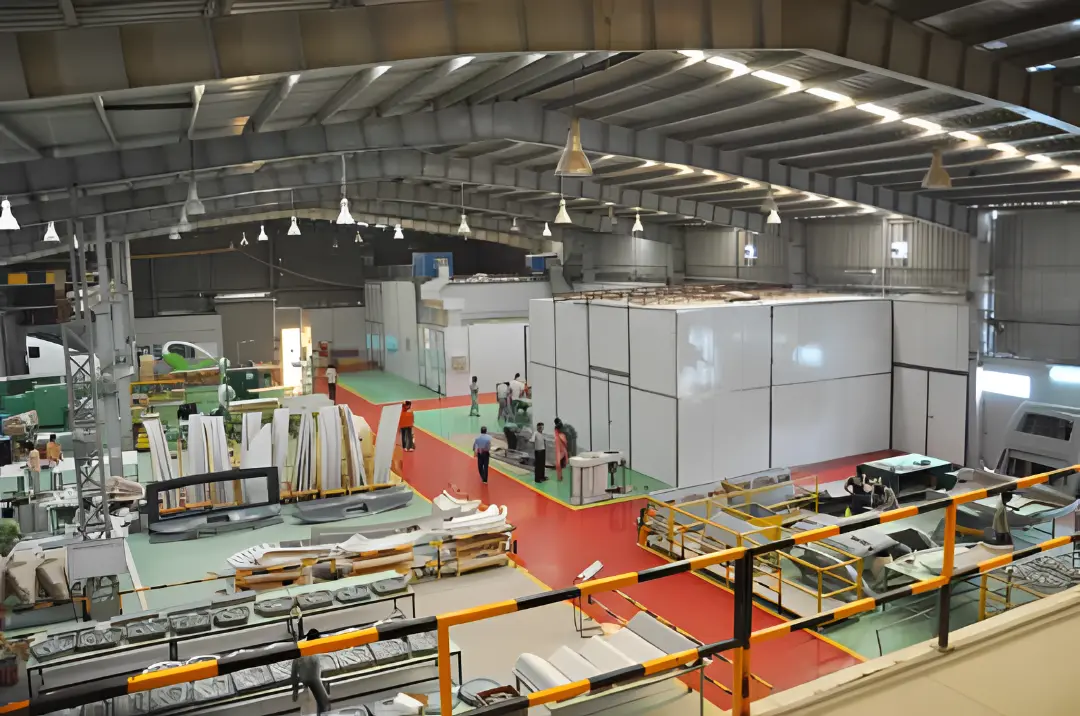
Lamination is one of the most fundamental processes in FRP manufacturing, involving the layering of fibre reinforcements with resin either manually or through semi-automated techniques. This process allows manufacturers to control the thickness, strength, and orientation of fibres based on the application, making it highly adaptable for complex geometries and customized requirements. While it may appear simple, lamination demands skill and precision to ensure uniformity and structural integrity across layers. It forms the very foundation of FRP components, where the material is gradually built into a functional and durable structure.
Gelcoat Application
Gelcoat application is the first step in the moulding process, where a specialized coating is applied to the inner surface of the mould before any reinforcement layers are added. This layer defines the final surface finish, providing not just aesthetic appeal but also protection against environmental factors such as UV radiation, moisture, and chemical exposure. A well-applied gelcoat ensures a smooth, defect-free surface while enhancing the durability of the component over time. In many ways, it sets the standard for both appearance and longevity in FRP products.
Paint Booth Finishing
Once the component is moulded and processed, finishing takes place in a controlled paint booth environment to ensure uniform coating and high-quality surface treatment. These booths are designed to eliminate dust and contaminants, allowing for a clean and consistent application of paint or protective coatings. Beyond aesthetics, this stage also contributes to additional protection against wear, weathering, and operational exposure. The paint booth phase is where the product achieves its final visual and functional refinement.
Clean Room
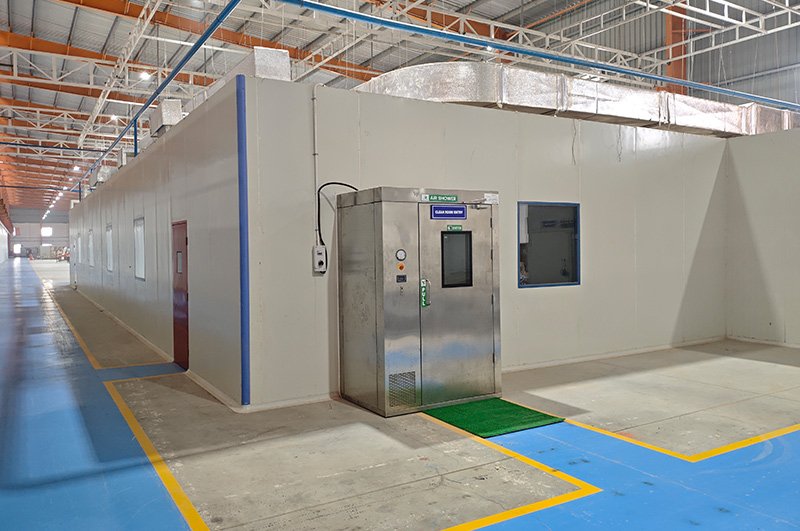
A clean room environment, classified as ISO 8 or Class 100K, is designed to maintain strict control over airborne particles and contaminants during sensitive stages of manufacturing. In FRP production, this becomes particularly important when working with high-precision components where even minor contamination can affect bonding, finish, or structural performance. By regulating air quality, humidity, and particulate levels, clean rooms ensure consistency and reliability in output. This level of environmental control reflects a commitment to precision where quality is built into the process itself.
Cold Storage
Cold storage facilities maintained at temperatures such as -18°C are essential for preserving raw materials like resins and prepregs used in FRP manufacturing. These materials are sensitive to environmental conditions and can begin to degrade or prematurely cure if not stored correctly. By maintaining controlled low temperatures, manufacturers ensure that the material properties remain stable until the point of use. This step, though often behind the scenes, plays a crucial role in safeguarding the integrity and performance of the final composite.
Curing Oven with Vacuum Facility
Curing is the stage where the composite transitions from a layered assembly into a solid, high-strength structure, and this is achieved using controlled heat and, often, vacuum assistance. A curing oven with vacuum capability helps remove trapped air and voids, ensuring a dense and uniform material structure. The combination of heat and pressure allows the resin to fully bond with the reinforcing fibres, delivering optimal mechanical properties. This process is critical in defining the final strength, durability, and reliability of the FRP component.
GRC Mixing and Spray Systems
Glass Reinforced Concrete (GRC) systems, while distinct from FRP, often complement composite manufacturing capabilities by enabling the production of durable and lightweight architectural or structural elements. The mixing process ensures uniform distribution of fibres within the concrete matrix, while spray systems allow for efficient and controlled application onto moulds or surfaces. These technologies expand the scope of advanced material manufacturing, offering solutions where both strength and design flexibility are required. Together, they represent an extension of composite thinking into broader construction and infrastructure applications.
MSL’s Approach to FRP Manufacturing
At MSL, FRP manufacturing is approached as a discipline of precision, consistency, and control. With dedicated infrastructure spanning advanced moulding technologies, controlled environments, and specialized processing zones, the focus remains on ensuring that every stage—from material handling to final finishing—meets defined quality standards. This integrated setup enables the delivery of components that are not only structurally reliable but also consistent in performance and finish. It reflects a manufacturing philosophy where process integrity directly translates into product excellence.
Final Thoughts
FRP is often seen as a material advantage. In reality, it’s a process-driven advantage. Because in composites, performance isn’t just designed—it is built, layer by layer, condition by condition. And the difference between average and exceptional lies in how well every one of these processes comes together. Click here to know more about FRP manufacturing on our website.
.jpg)

.png)

_(1).png)